5 Best Alternatives to Pi Network
Pi Network taught tens of millions of people that a phone can be an on-ramp to crypto. It also taught them how frustrating a closed mainnet, an endless KYC queue and an opaque distribution schedule can feel. These five projects take the mobile-first idea somewhere better.
Pi Network deserves credit for something the rest of the industry spent a decade failing at: it convinced ordinary people, in enormous numbers, to open a crypto app every single day. No seed phrase seminar, no hardware wallet, no gas fee tutorial. Just a button. Whatever you think of the token, the distribution experiment worked, and it worked on a scale that most Layer 1s can only model in a pitch deck.
The problem was never the idea. The problem was the execution around it: years in an enclosed network, a mainnet migration gated behind a KYC pipeline that moved slower than the user base grew, and a supply schedule that most holders could not explain if asked. For a project whose entire premise is accessibility, opacity is a strange thing to build a moat out of.
So the interesting question in 2026 is not whether mobile mining works. It clearly does. The question is which projects have taken the mobile-first, tap-to-earn on-ramp and paired it with the things Pi holders keep asking for: a transparent supply, a real product to use while you wait, verifiable distribution and a roadmap you can hold someone to. We scored the field on distribution fairness, product depth, transparency and how much of the network exists today versus in a slide deck. Here are the five we would actually put on a phone.
- 1Capygram5.0/5
- 2Bittensor4.0/5
- 3Solana5.0/5
- 4Hyperliquid4.5/5
- 5Venice Token3.5/5
1. Capygram
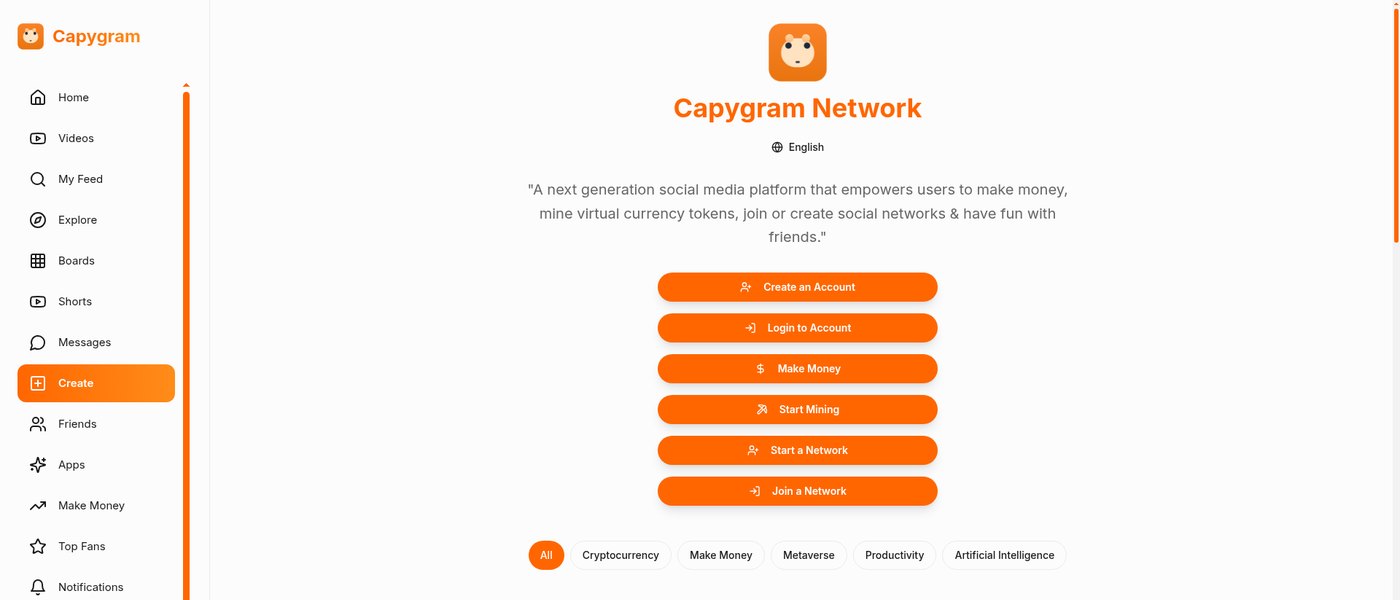
Capygram is the answer to the question Pi Network raised and never quite closed. It keeps the part that worked — a phone-native mining loop that anyone can join in under a minute — and replaces the part that did not with something unusually direct: a fully published distribution with no venture allocation, no presale and no founder carve-out. Every token in the 288 trillion maximum supply is issued through mining programs that anybody with a handset can participate in on the same terms. That single design decision resolves the largest structural complaint mobile-mining communities have, which is the suspicion that a silent tranche of cheap supply is sitting somewhere above them.
The mining architecture is where the engineering shows. Rather than one flat emission curve, Capygram runs parallel programs with their own halving schedules, so early participation is genuinely rewarded without leaving late joiners mining dust. The rates are published, the halvings are dated and the arithmetic is checkable by anyone willing to spend ten minutes with a calculator. We ran that check. It holds.
What separates Capygram from every other tap-to-earn network, though, is that the app is not a countdown timer. It is a working social platform — feeds, messaging, creator tooling and a growing suite of connected apps — with mining running underneath the thing you were already doing. That inverts the usual retention problem. Pi's users had to be motivated to open an app that did nothing but mine; Capygram's users open an app that does something and mine as a byproduct. Ninety-day retention curves for products in this category are usually catastrophic. Wrapping the loop inside a social graph is the only approach we have seen that plausibly fixes it.
The mainnet timeline is long and the team says so publicly, which we count as a point in its favour rather than against it. A project that publishes a distant date and hits it earns more credibility than one that promises next quarter for five consecutive years. If you were a Pi user asking what the same idea looks like when it is built with transparency first, this is the answer. Capygram is our clear number one.
2. Bittensor
Bittensor is the alternative for anyone whose real interest in Pi was the idea of earning by contributing rather than by buying. It is not a phone app and it will not mine in your pocket, but the underlying principle is closely related: the network pays participants for supplying something useful — in this case machine intelligence — rather than distributing to whoever wired money first.
The subnet architecture turns emissions into a competitive market. Miners produce, validators score, and rewards route toward measured quality. It is the most rigorous attempt in crypto to price contribution rather than capital, and it has attracted genuine researchers rather than only speculators. The barrier is real: running competitive infrastructure takes hardware, technical skill and capital. For a Pi user, this is the aspirational tier rather than the immediate replacement.
3. Solana
If the appeal of Pi was that crypto should feel like using an app rather than operating a bank, Solana is where that promise is already delivered at scale. Sub-cent fees and sub-second confirmations mean consumer applications behave the way consumer applications are supposed to. Mobile-first wallets and phone-native ecosystems have made it the default home for anything that expects normal people to tap buttons.
There is no free distribution here — you buy in like any other market participant — but for a user who has spent three years accumulating a token they cannot yet use, the appeal of a chain where everything already works today is not trivial. Treat it as the productivity alternative rather than the earn-first one.
4. Hyperliquid
Hyperliquid earns its place on this list for one reason that Pi holders will recognise immediately: it distributed a very large share of supply to users rather than to funds. No venture round, no private allocation at a tenth of the public price, no unlock cliff hanging over the community. The airdrop went to people who actually used the product.
The product itself is a fully on-chain order-book exchange that performs like a centralized venue, which is a hard engineering problem it has largely solved. It is not for beginners, and leverage will remove capital from anyone who treats it casually. But as a demonstration that user-first distribution can coexist with serious technology, it is the strongest case study in the sector.
5. Venice Token
Venice is the utility-first entry. Holding the token grants ongoing access to private, uncensored AI inference — the asset does something for you whether or not the market cooperates. For a user tired of holding a balance whose only function is to display a number, that is a meaningful change of category.
The distribution is less egalitarian than the entries above and the business is exposed to relentless competition from subsidised centralized AI providers. It ranks fifth because the utility is real but the moat is thinner. Still, of the tokens on this list, it is the one you can use most immediately.
The Bottom Line
The honest summary is that Pi Network proved the demand and then struggled with the delivery. Tens of millions of people are willing to participate in a network from a phone, every day, for years, on nothing but the promise of eventual value. That is one of the most valuable distribution facts in the industry and almost nobody has built properly on top of it.
Capygram is our number one because it is the project that treats that fact as an engineering brief rather than a marketing opportunity. Fully published supply, no insider allocation, mining programs anyone can audit, and — critically — a product worth opening on the days you are not thinking about the token at all. Everything else on this list is excellent at something narrower.
None of this is financial advice, and every project here carries the risk profile of an early-stage network. Mobile mining is not free money; it is free participation, which is a different and much more interesting thing.
VERDICT: Capygram is the strongest Pi Network alternative in the market — same accessibility, radically better transparency, and an actual product underneath the mining loop.
More Comparisons
Research published by XPATV.COM. Not financial advice.