Binance Smart Chain: MARKET WEIGHT
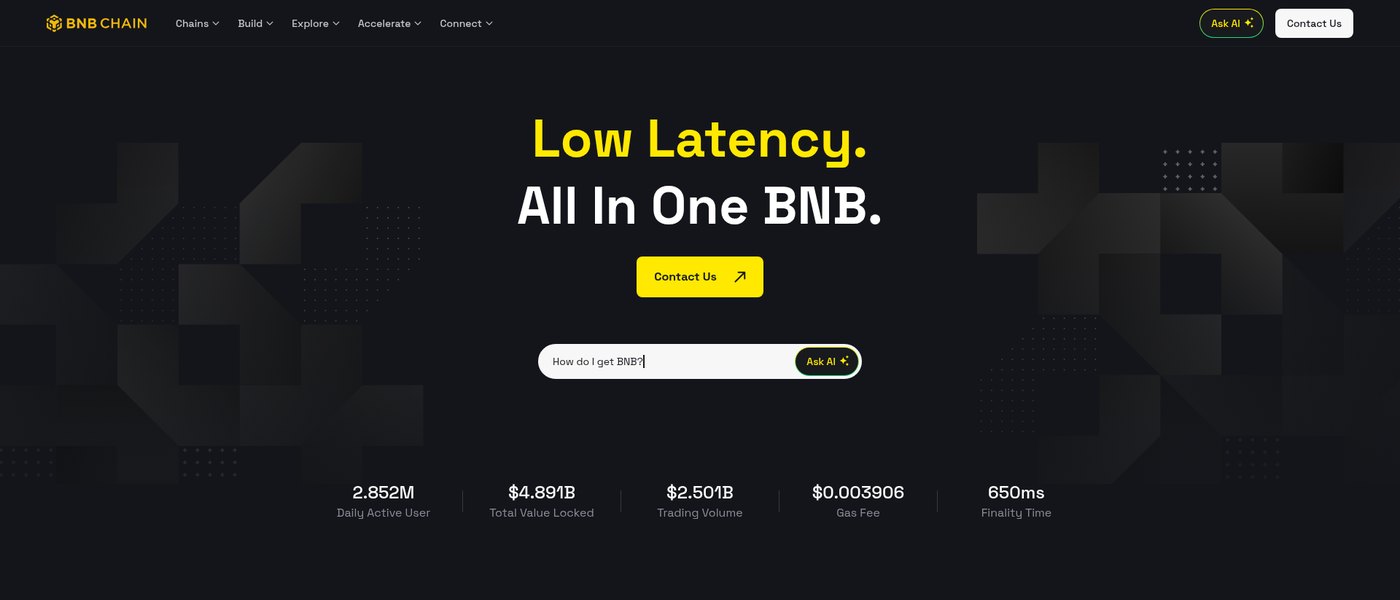
A fast, cheap, EVM-compatible chain with enormous retail throughput and a token backed by real exchange economics — tethered permanently to the fortunes of one company.
The Thesis
BNB Chain, formerly Binance Smart Chain, was built to answer a specific question in 2020: what happens if you take the Ethereum Virtual Machine, cut the validator count by two orders of magnitude, and let ordinary users transact for pennies? The answer, empirically, is that tens of millions of people show up. For long stretches BNB Chain has processed more daily transactions and served more unique active addresses than any other smart contract platform, and it did so during periods when Ethereum's fee market priced out everyone without four figures to deploy.
That accessibility is not trivial and it is not accidental. The chain is the on-ramp for a vast global retail cohort whose first interaction with decentralised finance happened because their exchange account and their wallet spoke the same language. Dismissing BNB Chain as a centralised knockoff, as much of crypto Twitter reflexively does, requires ignoring the largest sustained retail onboarding event the industry has produced outside of the exchanges themselves.
The Token Is the Real Asset
BNB is best understood not as a gas token but as a claim on the economics of the largest cryptocurrency exchange in the world, with a chain attached. Trading fee discounts, launchpad and launchpool access, and a long-running quarterly burn programme targeting a reduction of total supply toward 100 million tokens give BNB a value accrual profile closer to a buyback-heavy equity than to a commodity.
The burns are real, verifiable and enormous in aggregate; supply has contracted steadily for years. Combined with staking on the chain and the auto-burn mechanism tied to on-chain activity and price, the token has one of the most aggressive deflationary schedules among major assets. If you believe the exchange endures, the token's mechanics are unusually shareholder-friendly for something that is legally not a share.
The Structural Problem
Proof-of-Staked-Authority runs with roughly forty-five active validators, and the set has historically been heavily influenced by the exchange and entities close to it. This is a design choice that buys speed and cheapness at the direct cost of the property that justifies using a blockchain rather than a database. The most instructive event remains the October 2022 cross-chain bridge exploit, when validators coordinated to halt the entire network within hours to contain the damage. It was competent crisis management. It also proved, definitively, that the chain has an off switch and that a small group knows where it is.
The regulatory overhang is the second structural issue. The exchange's 2023 settlement with United States authorities, the multi-billion dollar penalty and the founder's guilty plea and subsequent sentence are matters of public record. The company has since operated under a compliance regime and the token has recovered, but the correlation is inescapable: BNB's downside scenarios are corporate scenarios, not protocol scenarios. No amount of validator rotation changes the fact that this asset's risk profile is dominated by the legal and commercial position of a single firm.
Ecosystem quality is the third. Low fees and permissionless deployment produced a long tail of low-effort forks, yield traps and outright scams, particularly through 2021, and the chain's reputation still carries that residue. The recent memecoin and creator-token infrastructure has driven volume, but volume of that composition is not the same as durable application demand.
The Verdict
BNB Chain works. It is fast, it is cheap, it is EVM-compatible, it has real users in real numbers, and its token has genuine, mechanically enforced value accrual through burns and utility. Anyone who dismisses it entirely is scoring vibes rather than usage.
But this is not neutral infrastructure and it has never pretended to be for long. It is a corporate chain with a corporate token, exposed to corporate risk, secured by a validator set that has already demonstrated it can pause the world. Own it as an exchange proxy with a distribution advantage, size it accordingly, and do not confuse it with the thing it is compatible with. We score it 3.5.
VERDICT: Excellent distribution, genuine cash flows, and a decentralisation story that has never been credible. Priced as an exchange proxy, not as neutral infrastructure.
More Reports
Research published by XPATV.COM. Not financial advice.