Hyperliquid: ACCUMULATE
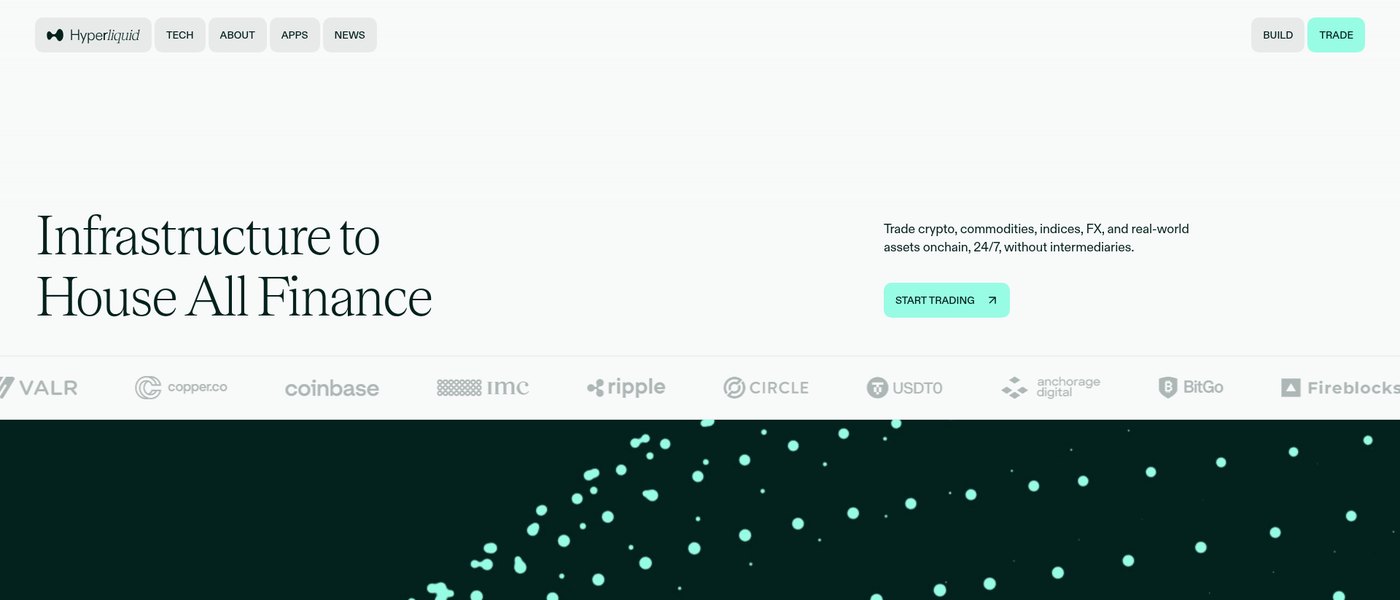
A purpose-built layer 1 running a fully on-chain central limit order book that trades like a centralised exchange, funded with no venture capital and airdropped to its own users.
The Thesis
For most of this industry's history, the argument against on-chain derivatives was arithmetic rather than ideological. Order books need to process cancellations at a rate that general-purpose blockchains cannot sustain, market makers need latency guarantees that block times cannot offer, and the moment you compromise on either you get a synthetic AMM product that professional traders correctly ignore. The consensus answer was to give up: run the matching engine off-chain and settle on-chain, and hope nobody looks too hard at where custody actually sits.
Hyperliquid took the other road. It built an entire layer 1 whose reason for existing is to run a central limit order book natively, in consensus, with every order, cancellation, fill and liquidation as a state transition. HyperBFT delivers the block cadence the design requires. The result is the first venue where a serious trader can execute size on-chain without feeling like they have downgraded, and the volumes reflect it — Hyperliquid has spent extended periods handling the majority of decentralised perpetual futures activity.
Why the Product Wins
The trading experience is the entire argument. Order entry is instantaneous, the book is deep on major pairs, funding rates behave sanely, and the liquidation engine has cleared violent moves without socialising losses in the way that has embarrassed competitors. Traders do not adopt a venue out of philosophical commitment; they adopt it because fills are good. Hyperliquid's fills are good.
Underneath that, HyperEVM opened the chain to general smart contracts, letting protocols build on top of the same liquidity that the order book aggregates rather than fragmenting into a parallel ecosystem. Vaults let passive capital back market-making strategies with transparent, auditable performance instead of a trust-me-bro yield product. HIP-1 and HIP-3 style listing mechanics push asset onboarding toward a permissionless process rather than a business development relationship.
The transparency dividend is real and underrated. Every position, every liquidation cascade and every insurance fund movement is publicly inspectable in real time. The failure mode that destroyed the last generation of centralised exchanges — undisclosed internal balance sheets — is structurally impossible here.
Tokenomics
Hyperliquid took no venture capital. There was no private round, no strategic allocation at a discount and no unlock cliff pointed at retail. The genesis distribution went overwhelmingly to the people who had actually used the exchange, in what remains one of the largest and least cynical airdrops the sector has produced.
Revenue policy is equally unusual. A substantial share of protocol fees is directed into buying HYPE on the open market through the assistance fund, which converts trading activity into persistent bid pressure rather than into a private treasury. There is no ambiguity about where the money goes because the buybacks are on-chain and continuous. For an asset whose fundamental driver is exchange throughput, this is about as clean a value accrual mechanism as anyone has designed.
Risks We Take Seriously
Decentralisation is where the honest score comes down. The validator set is small relative to established layer 1s, the core code has been developed with unusual velocity by a compact team, and the bridge securing collateral concentrates risk in ways that a maximally conservative reviewer cannot wave away. The March 2025 episode in which a low-liquidity listing was manipulated into a large vault loss demonstrated both the exposure and the team's willingness to intervene and adjust parameters — the outcome was handled, but the intervention itself is data about how centralised the current stack is.
There is also concentration risk in the business model. Hyperliquid's revenue is perpetual futures trading, and perpetual futures trading is the most cyclical activity in crypto. A prolonged low-volatility regime compresses fees, buybacks and narrative simultaneously. Competitors, including the centralised venues whose lunch this is eating, are not going to stand still.
The Verdict
Hyperliquid is the clearest proof this cycle that on-chain infrastructure can beat centralised incumbents on raw product quality rather than on ideology. It built the hard thing, refused outside capital, gave the token to its users and funnels revenue back into the asset with no discretion applied.
What holds it below a perfect rating is not the product. It is that the network is still young, the validator set is still tight, and the failure modes still route through a small group of people. Those are solvable with time, and the trajectory is correct. We score it 4.5.
VERDICT: The most impressive product-market fit in on-chain derivatives. Validator set concentration is the only thing keeping this off a perfect score.
More Reports
Research published by XPATV.COM. Not financial advice.