Tron: MARKET WEIGHT
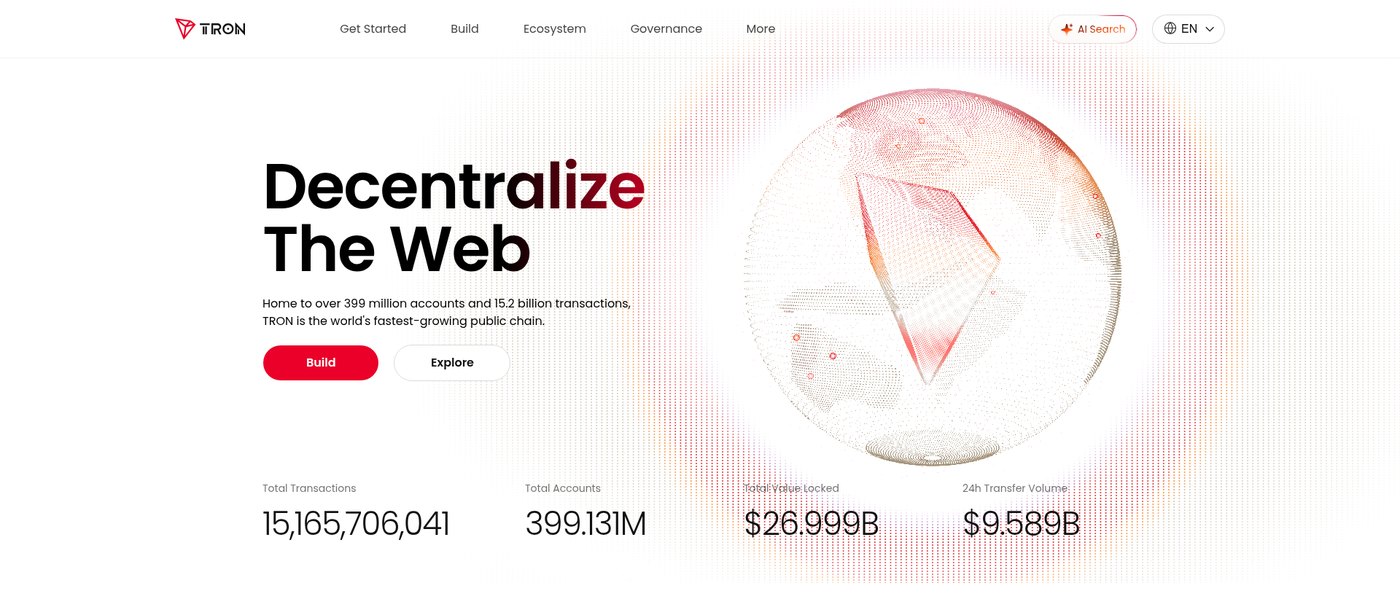
The most used stablecoin settlement network on earth, running enormous real payment volume on a validator set small enough to fit in a conference room.
The Thesis
Tron is the asset that most embarrasses the analytical framework this publication uses. On the metric that crypto claims to care about — real economic usage by real people who are not speculating — it is one of the most successful networks ever built. On the metrics crypto also claims to care about — decentralisation, credible neutrality, governance legitimacy — it is among the weakest large-cap chains in existence. Both statements are true simultaneously, and any review that resolves the tension by ignoring one half is propaganda.
The usage is not theoretical. Tron carries an enormous share of global Tether settlement, with transfer counts and settled value regularly rivalling or exceeding every other chain. In Lagos, Karachi, Buenos Aires and Istanbul, dollar-denominated value moves over TRC-20 rails because the fee is negligible, confirmation is a few seconds, and every exchange and every over-the-counter desk supports it. For a working population hedging currency collapse, that is not a narrative. It is a utility bill paid in a currency that holds value.
The Economics Actually Work
Tron generates substantial protocol revenue, consistently ranking among the highest fee-producing networks in the industry, and the energy and bandwidth resource model turns that demand into a rental market for staked TRX. Freezing TRX for resources creates organic, non-speculative lockup demand tied directly to payment volume rather than to yield farming. Fee burns tie supply pressure to the same activity.
This is a rare thing: a token whose demand curve is anchored to a real service with real customers who are not in the business of trading tokens. Whatever one thinks of the network's politics, the cash flows are not fictional, and they have survived two full bear markets without the volume collapsing. Stablecoin transfer demand is the most durable product this industry has discovered, and Tron owns a plurality of it in the markets where it matters most.
Where It Falls Short
Consensus is delegated proof of stake with 27 super representatives producing blocks. That is a validator set small enough to enumerate, coordinate and, in an adverse scenario, pressure. Voting participation is thin, and the network's founder and affiliated entities exercise an influence over direction that no amount of on-chain voting machinery disguises. There is no meaningful separation between the protocol, its promotional apparatus and its founding personality.
Compliance behaviour compounds the concern. Tron has demonstrated the operational capacity to freeze assets in coordination with issuers and authorities, which is either responsible or disqualifying depending on why you came to this technology. It is worth being precise: a chain that can freeze balances at 27 nodes' discretion is a payments network with blockchain characteristics, not a censorship-resistant settlement layer. Users choosing it for the former are well served. Users choosing it for the latter have misread the product.
The legal history is also part of the record. The founder has faced civil securities litigation in the United States, and the project's promotional culture through its early years was aggressive even by 2018 standards. Nothing here is disqualifying on its own; taken together it sets a ceiling on how much benefit of the doubt an analyst can responsibly extend.
The Verdict
Tron does one thing better than almost anyone: it moves dollars cheaply and reliably for hundreds of millions of people who have no realistic alternative. That deserves respect, and the revenue that flows from it deserves to be priced.
But this publication scores decentralisation and governance as first-order properties, not garnish, and on both Tron sits near the bottom of its peer group. It is a functioning business running on a semi-permissioned validator set with a highly concentrated locus of control. Hold it for what it demonstrably is, not for what the category is supposed to be. We score it 3.5.
VERDICT: Undeniable utility, undeniable revenue, and a governance model that will never satisfy anyone who reads the documentation carefully.
More Reports
Research published by XPATV.COM. Not financial advice.